

Disclaimer: The information provided in this article is for educational purposes only and is not intended to replace professional medical advice, diagnosis, or treatment.
The Daily Grind
Most of us spend at least a third of our lives at work. If you work for an organization, you likely work alongside colleagues and superiors. In these collective environments, our work is visible, and how we acquit ourselves as professionals shapes how others perceive us. The quality of our work are representations of our abilities, our calibre as workers. Our performance, then, becomes a visible measure of our potential, our contributions to the organization, our career prospects in the future.
Furthermore, work is often where we enact our self-concept. A person whose identity is built on achievement will strive for excellence, sometimes even at great cost. Someone else who longs for praise from others will often over-extend themselves for acclaim. Because the longing for achievement and affirmation stem from a need to reify the self, external outcomes rarely pacify the deeper need. Instead, the longing continues even as awards line people’s shelves and applause accompanies their name. The push to do more, to do better, becomes an unrelenting force.
Some people work in organizations with an unforgiving culture. Tight deadlines, competitive schemes, and long hours can inflict overwhelming stress on their nervous system. Others must adjust to constant scrutiny. Their superiors point out errors and give scathing feedback. In these conditions, workers can internalize the harsh standards imposed on them, thus subjecting themselves to a bitter perfectionism that feels both oppressive and inescapable.
Understanding Perfectionism at Work
We should all strive for excellence. It is healthy and beneficial, for us and our workplace, that we produce good work. However, perfect is often the enemy of good. Perfectionism is the attempt to achieve an impossible ideal, the failure of which causes distress and despair. Perfectionism paralyses rather than empowers us. Whereas aiming for excellence feels inspiring, perfectionism erodes our confidence. The more we try to get things perfect, the more self-conscious we become, the less sure of our abilities and choices.
People adversely affected by perfectionism often feel a persistent fear over making mistakes. They imagine worse-case scenarios where their mistakes are made public, where humiliation and reprimand damage their careers. They tend to over-dramatize the reactions of their colleagues or superiors. Though skillful, intelligent, and competent, they doubt their abilities and question their own judgement. Even a small task can take a long time, given the many doubts that arise. They revise and adjust, resist publishing the work. Under this barrage of self-doubt and stress, work can feel like an unrelenting source of torment.
Over time, this lack of confidence can become a self-fulfilling prophesy. Feeling unsure of oneself, the worker shies away from speaking up in meetings, or volunteering to take initiative on projects and events. As a result, the worker becomes less visible in the organization, and their talent remains unappreciated. Without recognition and advancement, the worker sinks into doubt. They start to view their own abilities in a negative light. Performance becomes charged with higher stakes, creating the conditions for heightened anxiety and stress.
This cycle can become a perpetual source of stress. Fortunately, there are some ways to help lighten the load of perfectionism and shift toward a healthier mode of function.
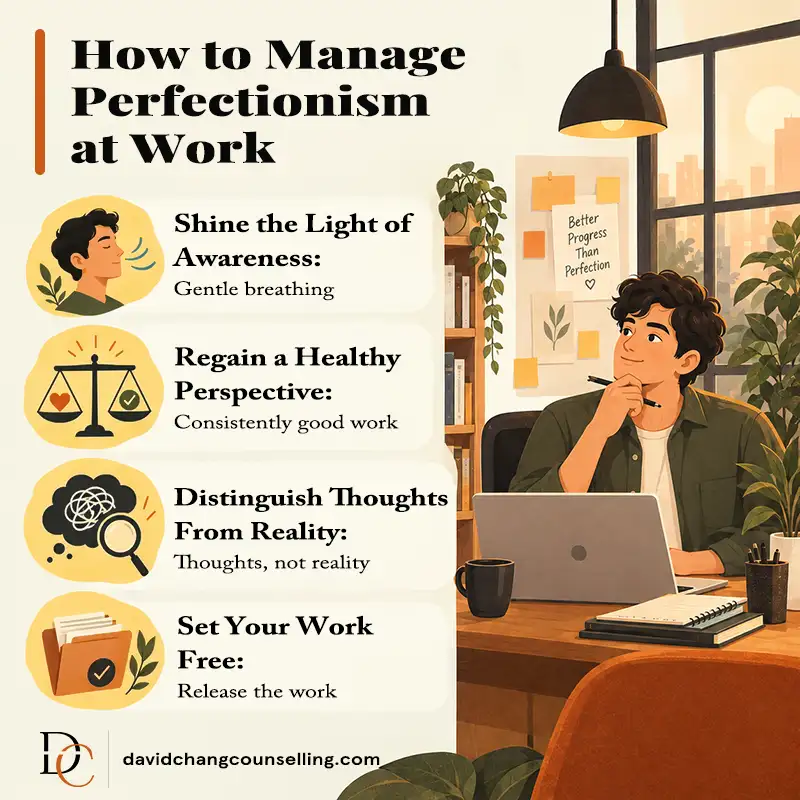
Shine the Light of Awareness
When perfectionism strikes, we are often immediately seized by anxiety and stress. We may experience sensations in the body: tension in the chest, a knot in the stomach, heat rising to our faces, sweat pouring from our pores. Breathing may quicken, our pulse begins to race. We may be snatched by thoughts of catastrophe.
In these moments, when our nervous begins to ramp up toward a stress reaction, we can shine some awareness on our condition, and gently hold a warm space for ourselves amid our distress. We can meet the anxiety with some tenderness. If we reprimand ourselves for feeling stressed, we will have exacerbated our distress. It’s important to meet ourselves without judgement, without reproach. Once we catch ourselves in the grip of perfectionism, we can intervene with gentle breathing, a moment of silence and reflection, to help calm our frazzled nervous system.
Regain a Healthy Perspective
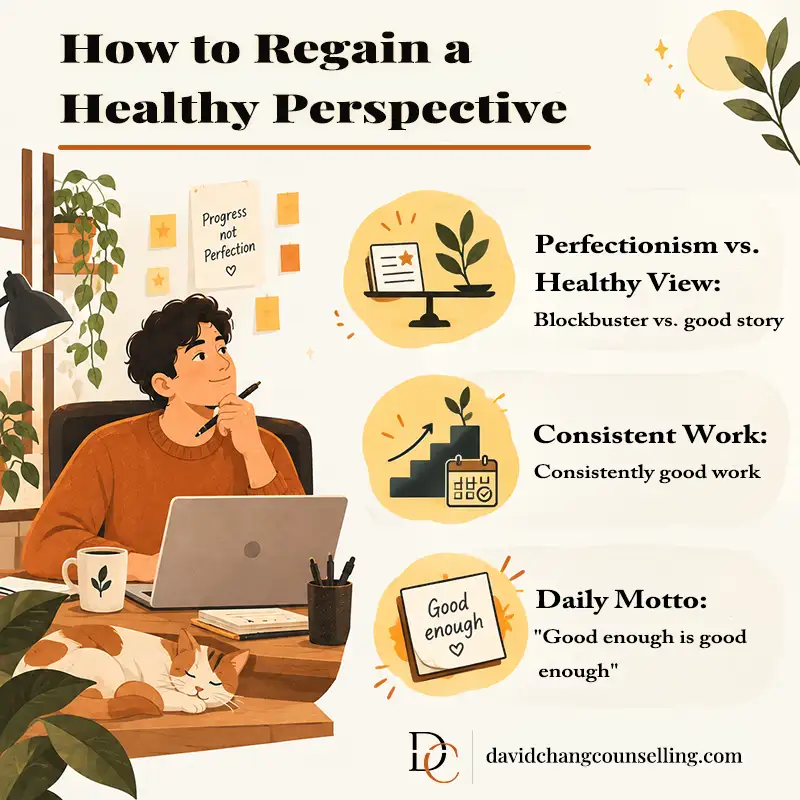
Perfectionism says: you must write a script that will become the next blockbuster. A healthier perspective says: Write a good story that you can be proud of. Perfection says: You must knock it out of the park. Healthy perspective says: It’s not about hitting a home-run; it’s about a good batting average over the course of a long career.
Perfectionism tends to over-emphasize the present task. It dreams of catastrophes that are not proportional to the actual outcomes. Consistency is more important, and more conducive to success than isolated spurts of brilliance. Consistent good work is better than flawless work that only appears occasionally.
A classmate of mine used to say: “good enough is good enough!” At the time, I was worried that this statement might endorse mediocrity. However, as an antidote to perfectionism, she was entirely right. To remind yourself of a healthier perspective, write a motto and keep it close at hand. The motto might be: “consistently good is better than occasionally perfect,” or “perfect doesn’t exist, but there’s plenty of excellence in my hands.” When you feel yourself captured by perfectionism, these reminders can be the keys to freedom.
Distinguish Thoughts From Reality
Perfectionists are often plagued by a harsh form of self-talk. When it comes to work, this negative self-talk can impede progress on a project or undermine confidence in performance. The self-talk might look like this: “This email is too short; everyone can see that it has no substance,” or “What if there is another error, or a loose end that I’ve forgotten to plug?” These “what ifs” can keep us from finishing a project.
If you are paralyzed by the possibility of negative scenarios, pause and make a distinction between thoughts and reality. Our minds project scenarios into the future. The scenarios can be vivid and convincing. However, they don’t often materialize. However, it’s important to recognize that, no matter how convincing, these projections are thoughts, not reality. They may have the appearance of reality, but they remain nothing more than a conjuring of the mind. When thoughts of catastrophe loom large, we can pierce through the illusion by saying to ourselves:
These are thoughts. These are only thoughts. These are only my thoughts.
By coming back to this reminder, we are less likely to be over-powered by negative thoughts.
Set Your Work Free
Pablo Picasso once said:
“A painting is never finished. It is abandoned.”
A person with high-standards can take things to the extreme by tinkering without end. However, perfection is a receding horizon line that we never reach. If we do not stop and allow the work to see the light of day, the work will have all been in vain. It may as well not exist. Therefore, at the end of every project (or email, document, assignment), we must step in and make a call. We must decide in favour of good in order to resist the tyranny of the perfect. This is not always easy, but making the call brings freedom for both you and the work that you’ve done. No one can see or benefit from your work if you do not let it out into the world.
It may feel extremely difficult to deem your work complete. It may feel that there are no assurances or guarantees, nor any glaring signal that you are done. This is very normal, and is part of the process. The work rarely shows us that it is done. Instead, you have to be the judge. This is why, despite our insistence and need for control, we must force ourselves to stop. Hence, Picasso’s word: abandon.
Help Is Available
Many people struggle with perfectionism to some degree. This is a good indication that someone is conscientious and wants to do well. Let’s recognize and celebrate this noble quality. At the same time, we can strive for excellence without being bogged down by perfectionism.
If you can function amid moderate stress, are able to regulate feelings of anxiety, then you are within the window of optimum performance. However, if you find yourself paralyzed by a fear of failure, or if perfectionistic tendencies at work are affecting your personal life, please know that professional help is available. Consider contacting me for a free consultation.
About the Author: David Chang, PhD, RCC, is a Vancouver counsellor and educator. With over 20 years of experience in evidence-based modalities, David helps individuals navigate workplace stress, life transitions, and personal growth.


