

Disclaimer: The information provided in this article is for educational purposes only and is not intended to replace personalized professional medical advice, diagnosis, or treatment. If you are experiencing chronic insomnia or severe anxiety, professional support is highly recommended. Please contact us to see how we can help, or consult your primary healthcare physician.
Why Does Your Mind Race at Night?
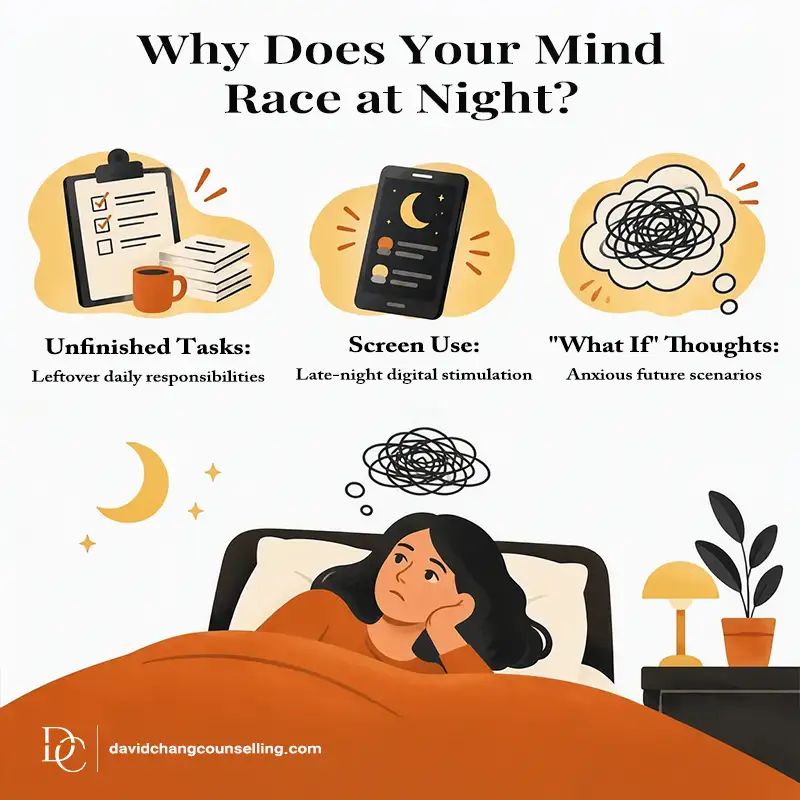
Many people struggle with anxious thoughts at night. After a day of work, school, caregiving, they hit the pillow with their heads spinning, tired but wired. Despite the hard work, there are responsibilities left unattended, tasks to complete, items on their checklist yet to be ticked off.
To make matters worse, many people turn to their screens to wind down. However, instead of finding relief, their eyes are bombarded with more stimulation, from trivial amusements to news of doom. The “what ifs” start to haunt their inner landscape. What if interest rates go up? What if I bomb the presentation? What if I freeze during the exam? What if my son doesn’t get into the desired university? So begins a struggle to find rest for a restless mind.
Luckily, there are practical ways to ease ourselves into sleep. When integrated into habit, the practices can moderate an overactive mind and draw out our inherent ability to fall asleep. Consistency is key. A bedtime routine is not an instant solution to a restless night. Rather, it is a lifestyle change that promotes better rest over time.
Try to incorporate these routines one at a time. If something doesn’t work over the course of two weeks, make small adjustments to find something that better suits you.
5 Practical Habits to Ease an Overactive Mind
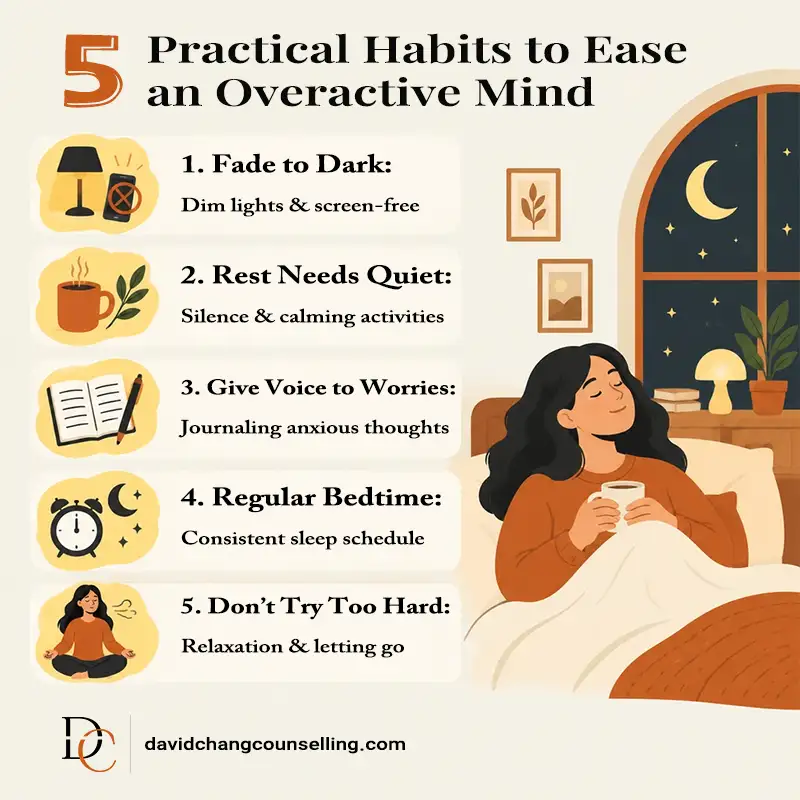
1. Fade to Dark
Our bodies have a circadian system that works with sunlight to regulate its sleep rhythm. During the day, our brains register light and primes itself for wakefulness. After sunset, the ensuing darkness signals the brain to produce melatonin (the sleep hormone), which naturally prepares the body for sleep. Artificial light can often interrupt this process. Bright lights from our homes and our screens can disrupt the body’s circadian function, prolonging wakefulness (an overactive mind) even when it’s time to fall asleep.
To help ease the transition to sleep, try to have dim soft light around your home. Avoid bright fluorescent lights. Local illumination (like lamps) can provide ambient light without filling your home with glare.
Limit your use of screens two to three hours before bed. If you struggle with over-thinking, the stimulation from your devices can further aggravate your over-active mind. Try to keep a “screen-free” period at least 2 hours before bedtime.
2. Rest Needs Quiet
To ease into a quieter state of mind, we need quiet surroundings. Sound is to our ears what light is to our eyes. Loud noises that blare from speakers, headphones, computers, or TV, tend to activate, rather moderate, our busy minds. Periods of silence can help to ease the nervous system, signalling to the brain that we are ready to go to sleep.
Quiet activities like reading or drawing can be a calming way to wrap up the day. Some people finding knitting a calming hobby that gets them ready for sleep. Others find mindfulness exercises a good way to quiet the mind.
3. Give Voice to Worries
If lingering thoughts continue to assail you, this may be an indication that the thoughts need to be acknowledged and given proper voice. I suggest writing down a list of worries. In listing our anxieties, we are not indulging in them, nor are we trying to solve any of them. Rather, we acknowledge them by giving them their proper place. It is as if we are putting a litter of rambunctious puppies to rest. We pick up each puppy and place them in a little bed. We write down each worry, knowing that they can stay on that page for the night.
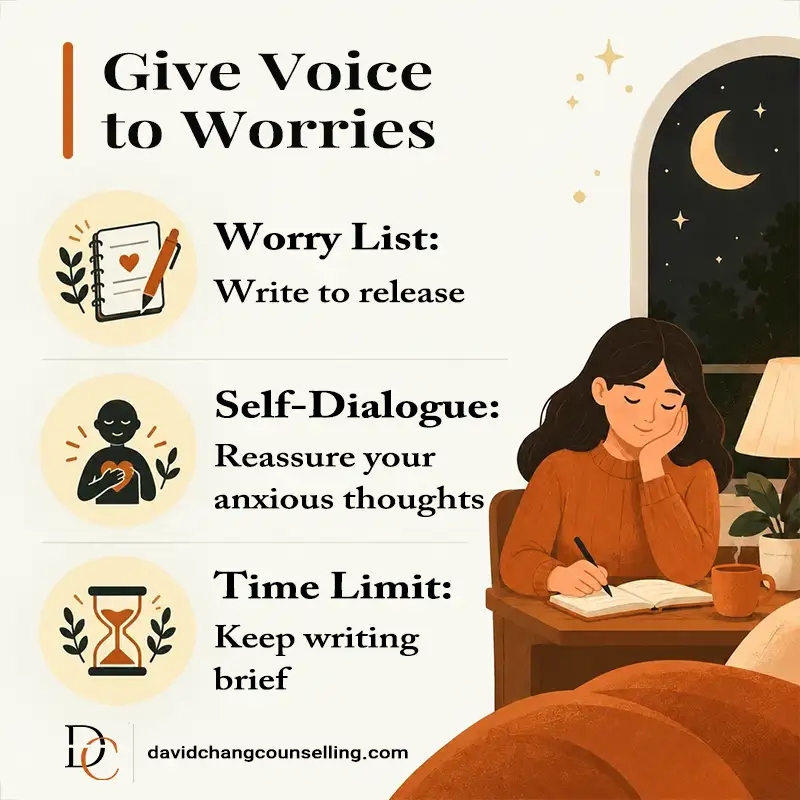
Self-guidance is another writing technique. In essence, you write a dialogue between two parts of yourself: the anxious part, and a calm, sage-like part of yourself. Start with the anxious, over-active part of you. What would you say? Then, write down a reply from the part of you that is serene and wise. The dialogue might look something like this:
Anxious me: I’m so worried about the exam on Thursday!
Wise me: Why are you worried?
Anxious me: There’s so much material to know. I have been studying, but I still have so much to cover.
Wise me: Sounds like a challenge. Have you been studying consistently?
Anxious me: Yes, everyday.
Wise me: So you’ve been doing your best?
Anxious me: Yes. But it’s not enough.
Wise me: We don’t have to think about what is enough or not enough. What is left to review?
Anxious me: Chapter 4 and 5.
Wise me: How will you organize your time so can review those chapters?
Anxious me: I guess I can do chapter 4 on Tuesday, and Chapter 5 on Wednesday.
Wise me: That sounds like a good plan. Do you feel better now that you’ve laid out a plan?
Anxious me: I think so.
Notice how each anxious thought finds a more measured and calm reply from the wise self. By accessing this part of us that is already composed and serene, we can bring a touch of peace alongside the anxiety that we feel. The point is not to abolish anxiety or to dispel the overthinking – it is to enter into dialogue with it, so that the overactive mind does not take centre stage or have the last word. If we can always accompany ourselves with our inner sage, then we can moderate the overactive mind and soften its power over us.
Please keep the writing activity to a set time. The aim is not to write ourselves into a frenzy, but rather to acknowledge our worries, find them a proper place, and set them aside.
4. Regular Bedtime
Many people struggle with an overactive mind at night because their bedtimes vary wildly. One night, they may go to bed at 2am; another night they may be in bed by 10pm to make up for a previous night’s sleep. Irregular sleep schedules often confuse our circadian rhythms, disrupting our bodies’ natural tendency to wind down at a specific time. Overthinking can sometimes be a symptom of a mind that has not learned to settle down at a certain time, because bedtime is different every day.
To help train our minds to quiet down, establish the habit of going to sleep at a regular time every day. Over time, this practice (along with the other suggestions mentioned above) can help restore our bodies’ ability to fall asleep.
5. Don’t Try Too Hard
Although an overactive mind can feel like a problem that requires a solution, our efforts toward abolishing our thoughts can be counterproductive. Sleep is about relaxation. We ease and soften into it, hence the term fall asleep.
We cannot overcome a busy mind by working harder to change it. Instead, we melt away the tension, let go of our agenda.
If the mind is busy, we simply acknowledge its busyness and give it some space to be. We can try some progressive muscle relaxation techniques to help our bodies settle into bed, but without any agenda that our thoughts would dissipate. We simply let the tightness in our body melt away, along with the activities and memories of the day. We allow ourselves to be held in the nest of darkness.
Frequently Asked Questions (FAQs)
Q: What if I fall asleep fine but wake up at 3 AM with my mind racing? A: This is a very common experience. If you find yourself awake for more than 20 minutes, avoid the temptation to stay in bed and toss and turn. Gently get out of bed, move to a dimly lit room, and engage in a quiet activity like reading. Return to bed only when you feel sleepy again. This helps your brain associate your bed with sleep, rather than with anxiety.
Q: Will taking melatonin or sleep supplements stop my nighttime overthinking? A: While sleep aids might offer short-term physical relief, they do not address the root cause of an overactive mind. In my practice, I find that relying solely on supplements can sometimes prevent us from developing our own natural capacity to wind down. Building consistent, mindful habits provides a much more sustainable foundation for restful sleep.
Q: Does the “no screen” rule apply to e-readers or tablets with blue-light filters? A: Blue-light filters do reduce the disruption to your melatonin production, which is helpful. However, the content you consume—like an intense novel, a thrilling movie, or the news—can still stimulate your nervous system. If you choose to use an e-reader, opt for an e-ink display, keep the brightness very low, and choose calming material.
Q: Can what I eat or drink during the day affect my thoughts at night? A: Absolutely. Caffeine has a long half-life and can keep your nervous system elevated long after your last cup. Similarly, while alcohol might initially make you feel drowsy, it often leads to fragmented sleep and “rebound anxiety” in the middle of the night. It is best to avoid caffeine in the afternoon and limit alcohol before bed to give your mind the best chance at peace.
Q: How long does it usually take for these bedtime routines to actually quiet my mind? A: Re-training your mind and circadian rhythm requires patience. For most people, it takes about two to four weeks of practicing these habits daily to notice a significant shift. Remember not to try too hard; treat this as a gentle lifestyle adjustment rather than a rigid goal to achieve overnight.
When to Reach Out for Help
These practical suggestions, when implemented consistently overtime, can form a suite of healthy habits that help people fall asleep more easily without the annoyance of a busy mind. None of these practices are ad-hoc solutions to an overthinking. However, when they become habits, they provide the necessary conditions for a more relaxed mind.
If you are persistently struggling with a busy mind at night, or if stress, anxiety, and depression are becoming an ongoing problem in your life, please contact us to book a free 15-minute consultation. As a Registered Clinical Counsellor (RCC) based in Vancouver, I offer targeted approaches like Cognitive Behavioural Therapy for Insomnia (CBT-I) to help you restore your sleep and peace of mind.
About the Author: David Chang, PhD, RCC, is a Vancouver counsellor, educator, and author. With over 20 years of experience in mindfulness practices and evidence-based modalities like CBT and ACT, David helps individuals navigate life’s difficult passages.


