

Disclaimer: The information provided in this article is for educational purposes only and is not intended to replace personalized professional medical advice, diagnosis, or treatment. If you are seeking mental health support, please contact us to see how we can help, or consult your primary healthcare physician.
For people looking for a mental health professional, it can be confusing to differentiate between various qualifications and professional titles. What is a psychotherapist? How do psychologists differ from clinical counsellors? In this article, I want to provide a brief and accessible primer on these professional designations, so you can be better informed about the kind of professional help that best suits your needs.
The information provided in this article applies to British Columbia only. Clients in other provinces and jurisdictions may be regulated by different professional governing bodies. Laws and regulations related to mental health continue to shift. The information is relevant as of November 2026.
What is the difference between a therapist, a psychologist, and a counsellor?
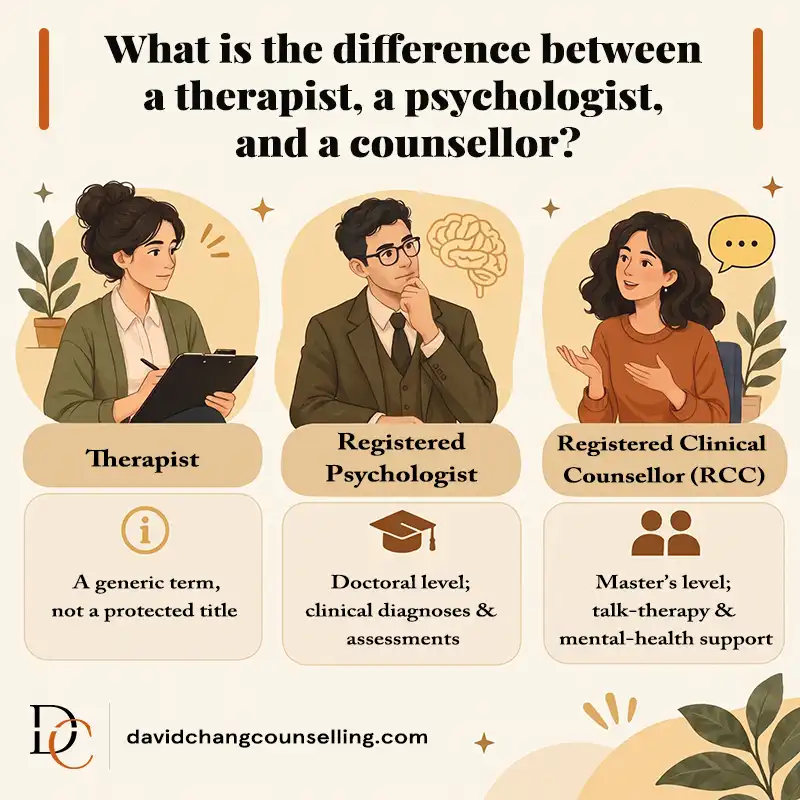
A “therapist” (or “psychotherapist”) is a generic term used in everyday speech to denote someone who works in mental health. The term “therapist” is not currently protected under any professional body, and there are no formal professional designations with exclusive rights to the word. While there are a number of professional bodies that use “therapist” as part of their professional title (for example, Registered Physiotherapist, or Registered Massage Therapist), “therapist” on its own is not a professional designation.
A Registered Psychologist is regulated by the College of Health and Care Professionals of BC (CHCPBC), and usually has a doctoral level of education, which includes graduate studies and a supervised practicum. Registered Psychologists are qualified to conduct psychological assessments and clinical diagnoses. Tests for ADHD, autism, and learning disabilities are usually conducted by psychologists. In addition to clinical diagnosis and assessments, many psychologists also provide therapy to clients seeking ongoing help and support.
A Registered Clinical Counsellor (RCC) is regulated by the British Columbia Association of Clinical Counsellors (BCACC). RCCs are qualified to provide a range of psychotherapeutic services in British Columbia. Members of the public can log into the BCACC website to check the status of any registered member. A registered counsellor in British Columbia has a minimum of a master’s level of education, which includes graduate studies and a supervised practicum. A counsellor is not qualified to conduct clinical assessments, but provides talk-therapy, and mental-health support for clients seeking short-term or long-term treatment. Counsellors are trained to work with a range of mental health challenges: depression, anxiety, grief, life-transition, self-esteem, burn-out, and relationship difficulties.
Neither psychologists nor counsellors are qualified to prescribe medications. Both can provide evidence-based mental-health treatments, like Cognitive Behavioural Therapy, Dialectical Behavioural Therapy, mindfulness practice, and many others.
Which mental-health professional is right for you?
If you are looking for someone to diagnose ADHD or autism, a Registered Psychologist will be able to conduct the required clinical assessment. Many psychologists provide talk-therapy for clients looking to resolve mental health issues. Because Psychologists have doctoral-level education, their fees will reflect their level of qualification and expertise.
If you are looking for talk-therapy, and do not require a clinical assessment, a counsellor can be a very good option. Fees for counsellors vary widely. Although all counsellors must have a master’s degree, some RCCs hold PhDs, and their fees will reflect their qualifications.
It is appropriate to ask your mental health professional about their level of experience and education. Feel free to initiate a conversation with your therapist about their relevant training and expertise.
Most insurance providers cover psychotherapy from both psychologists and counsellors. Please check your insurance coverage to ensure that you have access to their services.
Finding the Right Counsellor in Vancouver

Qualification, training, and experience are important factors in finding the right counsellor in Vancouver. However, it is often more important to find the right fit. One set of qualifications do not guarantee the optimal alignment between therapist and client.
The vibe, warmth, rapport, and connection that a client feels with a therapist is vital to the therapeutic process, but hard to specify with a set criteria.
Most counsellors offer a free consultation to clients who inquire about their services. The consultation provides an opportunity to get acquainted with your counsellor. You may consider asking the following questions:
- What is your approach to counselling?
- What are the primary modalities you use?
- Do you have specific training and experience that is relevant to my situation?
- What do you recommend as a course of treatment for my situation?
Your counsellor may provide some ideas for treatment, while also acknowledging that treatment is often a collaborative (rather than prescriptive) process that involves ongoing participation and engagement with the client. In terms of the therapeutic alliance, please consider the following questions:
- Do I feel comfortable and safe with this counsellor?
- Does the counsellor seem empathetic and caring?
- Is the counsellor wise and understanding in a way that makes sense to me?
Having a tentative answer to these questions may help you decide on a mental health professional that is right for you.
Begin the healing journey
If you are currently looking for a counsellor, it is often prudent to speak to a few counsellors to determine the right fit. Feel free to check with the professional body, like the BCACC, to confirm the counsellor’s qualifications. If first impression draws you to a counsellor, please proceed with an initial appointment. Keep in mind that it usually takes a few sessions for a therapeutic alliance to take shape.
If you are ready to speak to a counsellor in the Vancouver area, feel free to contact me for a free consultation.
About the Author: David Chang, PhD, RCC, is a Vancouver counsellor and educator. With over 20 years of experience in evidence-based modalities, David helps individuals navigate life’s difficult passages and find the right mental health support.


