
The past year has been tumultuous for the world. In a span of weeks, things seemed to have further fallen into disaster. Carnage, destruction, chaos spread like vicious ripples across the globe. Conflict in the Middle East has seen widespread bloodshed, environmental devastation, disruption to commerce, political upheaval, and a stupendous shock to oil prices. Without an end in sight, the world’s economies are now bracing for fallout. Even if we do not fret under skies scored by missiles and drones, we are all rocked by the violent waves emanating from the Middle East.
In a globalized society, we are increasingly caught in an intractable contradiction. The domain of personal agency is set at odds with the dire state of the world. We may do everything within our power to optimize our health – exercise regularly, eat a healthy diet, obtain sufficient sleep – but the sum of our efforts may not result in a satisfactory feeling of wellness. In what way can one truly be well when war rages in distant lands, where children are killed by bombs, and burning refineries blot the sky with acrid smoke? Our own private paradise seems placid enough, but provides little comfort in the face of pending tumult. We see the artifice in full transparency. Anticipating the economic and political effects of war that will ripple across the globe, we are never truly at rest. Despite our efforts to take care of ourselves, an ailing world militates against our flourishing.
Against this backdrop of war, mental health seems a preoccupation both menial and inconsequential. This individualistic concern appears irrelevant, incongruous with the clash between nations, the collective traumas suffered by the masses caught in geopolitical strife. At the same time, that nations are mired in war does not expunge the reality of our individual lived experience. We commute to work, shop for groceries, prepare meals, take care of our children, pay the bills. Life does not stop; quotidian stressors do not relent. Duty continues to press its demands, albeit now with the dark cloud of war looming on the horizon. What are we to do – indeed, what can we possibly do – to ensure wellbeing in a world that is now in flames?
Urie Bronfenbrenner, a Russian-born, American psychologist, has long recognized that a person’s development and wellbeing does not occur in isolated environments. In contrast to the psychological research of his time, which examined the stages and mechanisms of development within individuals, Bronfenbrenner saw clearly how multiple and overlapping spheres of influence can affect our health and psychology. He constructed a comprehensive model of development known as the ecological systems theory, which identifies the influences of parents, family, institutions, culture, media, and political systems on individuals. Writing before the rise of the environmental movement in the 60s and 70s, Bronfenbrenner did not include the biosphere – despite his use of “ecology” in naming his theory – as a field of influence in a person’s wellbeing, an omission that proves glaring now that climate change degrades living conditions around the globe. Nevertheless, Bronfenbrenner’s theory posits a more holistic view of human wellbeing that acknowledges the complexity of our shared plight, the innumerable layers that shape our lives, individual and collective.
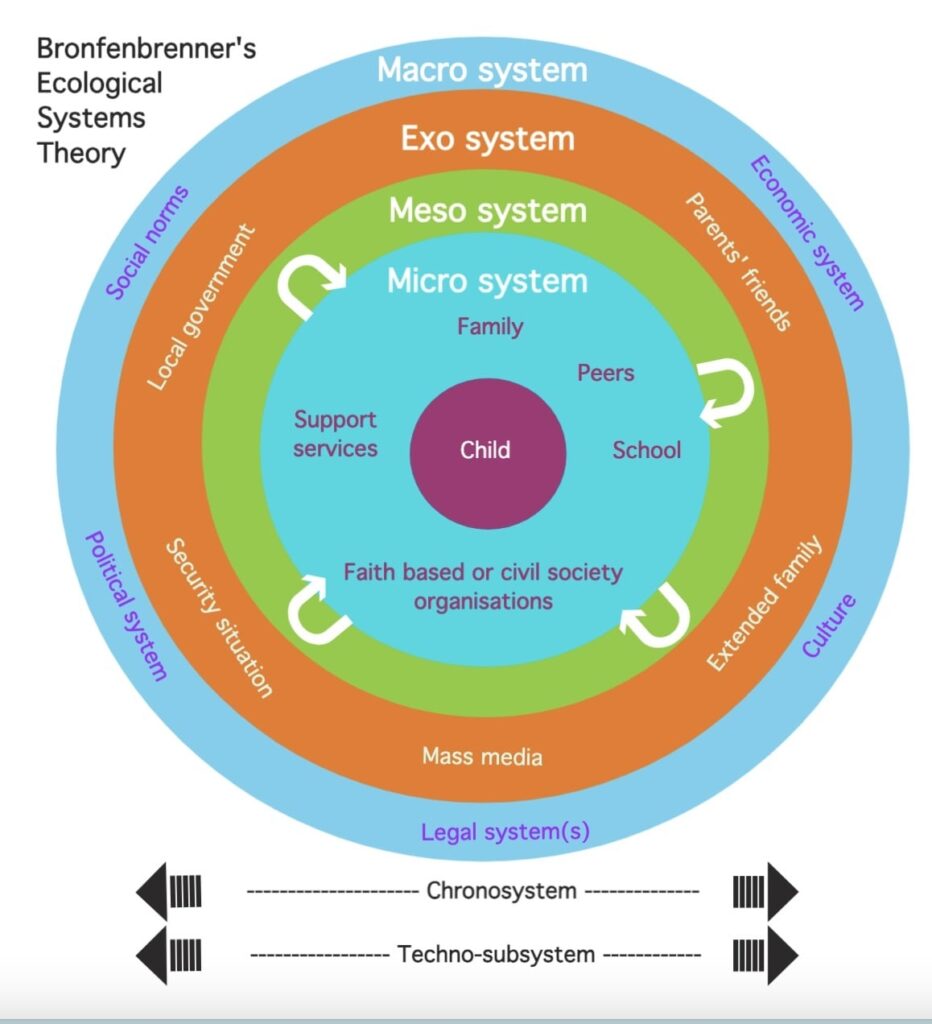
Bronfenbrenner’s Ecological Systems Theory
Given the interconnections that form the overarching environment of human life, we see that there can be no true individual happiness if larger spheres are hostile to individual flourishing. In what sense can there be true happiness if corrupt governments fail to uplift their citizens? How can there be happiness when legal institutions violate principles of justice? In what sense can there be a flourishing life when each day brings threats of bombs and missiles? For those living far away from the frontlines, the threat of war has wide-ranging consequences: rising prices, disruption to agriculture, economic shock. All of these forces bear on our psyche as we steel ourselves against the fray.
In short, our methods of self-care in times of global upheaval – such as daily exercise and meditation – are vital, but not nearly sufficient given the darkness that threatens us. We need these methods to help us complete the stress cycle, so we can metabolize the pain that assaults our system. At the same time, they offer no more beyond a way of coping; they are the aquatic equivalent of keeping one’s head above water. There are deeper fractures occurring within our souls. Our faith in humanity and our hope in a brighter future are irrevocably shattered by war. The stability we need to build a worthy life is cast into doubt. When little children are buried in rubble, when mothers wail in the streets with sons and husbands in their arms, we feel the gushing wound in the heart of the universe. Our coping mechanisms, necessary as they are, cannot address the profound anguish we feel in the face of violence and devastation.
Deep suffering must be met with depth of soul. The industrial-consumer culture is grossly inadequate in addressing existential questions of human meaning in a world of genocide and nuclear weapons. The transactional nature of counselling is not immune to the logic of capitalists culture: clients bring their malaise to the therapist, the therapist dispenses techniques and methods to help alleviate symptoms. However, there is no technique apt to redress the flagrant violation of life as war ravages millions. Bombs and missiles are a violent desecration of all that is sacrosanct. The rubbles of a flattened building is a searing condemnation of a species that excels at massacring itself. A psychotherapy that can offer no more than coping strategies is a feeble one indeed. In the face of indescribable suffering, the therapeutic framework must deepen so as to make space for inevitable tragedy, agony, uncertainty, insecurity, and the absurdity of life. Part of what makes being human so insufferable is the fact of our destructiveness, how we spin the cruelest fate upon ourselves, how we engineer our own demise through technological advancement, how we take a thousand rational steps toward madness. These are difficult realities to face. Confronted with this condition, the therapeutic goal is not to feel better, but to live more meaningfully amid widespread suffering. To name these realities, to speak honestly about our powerlessness in the face of destruction, is a small but vital act of fidelity to our humanity.
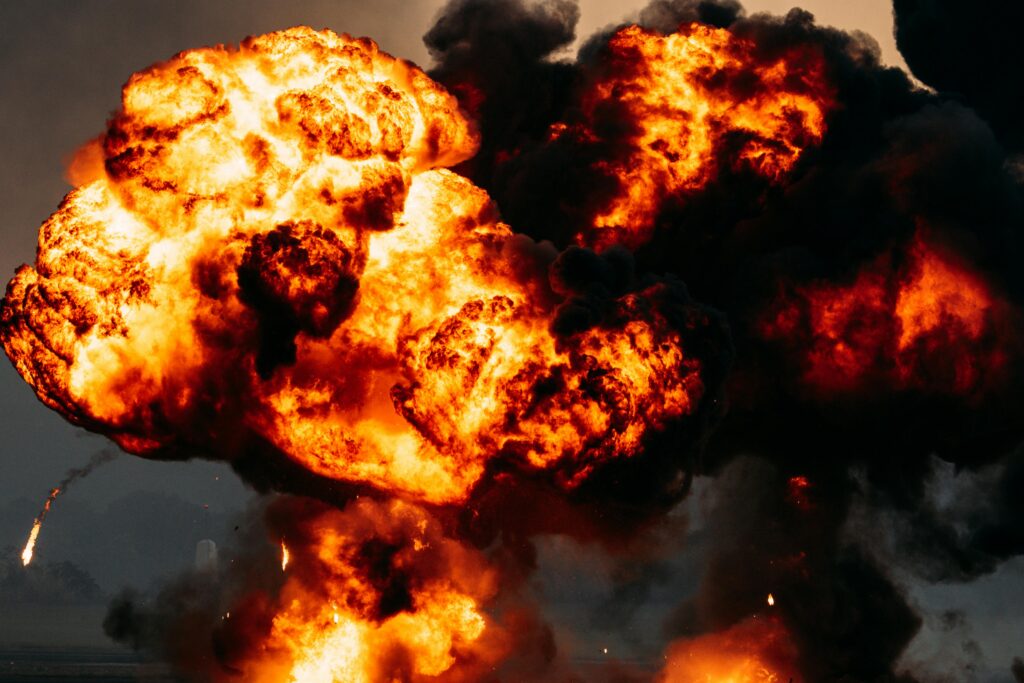
War shatters our faith in humanity, in a life worth living.
It is said that truth is the first casualty of war. However, the demise of truth begins long before the first salvo, and wars cannot end until those who wage them return to a radical honesty, something that they are rarely able to do. Belligerent leaders are unable to acknowledge the abyss of their own fear. They are afraid of other nations, afraid of their own people, afraid of the future, and afraid of life itself. They will persist in their fearful grip on power and insist on the same lies even as their tactical objectives fail to achieve strategic success, even as men and women in uniform bleed out on battlefields. For others struggling with the consequences of war, radical honesty asks us to face the enveloping darkness. By refusing to turning away, we are better positioned to meet the appropriate emotions that arise: grief, anguish, despair, outrage, and the longing for justice. These are difficult valences; they are hard to hold, but hold them we must. They are appropriate responses to the horrors around us, and part of our human response to atrocity. Wars are waged in part by those who refuse to meet their own sorrow, to admit the possibility of their own vulnerability. In so doing, they deny their own humanity while denying the humanity of those who oppose them. In cycles of dehumanization, neighbours turn into competitors, competitors into adversaries, adversaries into enemies. To oppose this murderous cycle, we must dare to face our own humanity, and in so doing, dare to see the humanity in our enemies.
It is in the exploration of meaning amid devastation that we can find a healing path. Techniques and coping strategies no longer serve us well in the terrain we now find ourselves. The language of coping, of survival, seems bland and powerless. Instead, we need a robust and august language apt to name the tectonic forces that rock us. We can look to Camus, who saw our Sisyphian condition and still believed that we are larger than our fate. We need the wisdom of Victor Frankl, who wrote: “everything can be taken from a man (sic) except one thing. . . to choose one’s attitude in any given set of circumstances, to choose one’s own way.” We need encouragement from William Ernest Henley, who wrote: “It matters not how strait the gate, how charged with punishments the scroll, I am the master of my fate, I am the captain of my soul.” These words do not have a place in modern therapeutic culture, but they emanate from the ashes of anguish, pulsing with sober wisdom. They come from an intimate understanding of suffering, and thus they present an authentic resilience and transcendence that conventional and modal forms of therapy cannot offer.
Honesty is the oxygen of therapy. Both therapists and clients alike have a responsibility to be honest about the situation at hand. The powers that control global events now extend far beyond our limited sphere of control as individuals. There is little that one can do in the short term to affect outcomes in the Middle East. This admission is neither resignation nor surrender. It recognizes the state of things as they are. If the levers and buttons are not within our reach, then we can be liberated from the anxious wrangling that torments us. We can moderate our fixation on the news cycle, which rivets our eyes and fries our nervous system. We can keep abreast of the latest developments while also remaining smart about our exposure to bad news. The loss of life, civilian and combatant, will provoke waves of sadness, disappointment and grief. We can honour these emotions by greeting them with kindness and understanding. We can see this adversity as a spur that refines our consciousness, a sword that induces awakening. When we stare into the pit of human depravity, we need a trenchant wisdom that equals the depth of our suffering. Wisdom and religious traditions can offer solace and hope in the darkest times. Poetry and art often express intuition and understanding that find no shape in words. Gestures, practices, and rituals can put us in contact with sacredness, which can provide grounding at a time when our feet find no purchase. Say a prayer, light a candle, look up to the sky and surrender our sorrows. We do not need to believe in any god or higher power to undertake these gestures, for the gestures themselves affirm the sanctity of life. By performing them, we nourish and sustain our humanity. and
In the longer term, we can work to reform and strengthen the structures of democracy, so that our institutions become resilient against tyranny and its abuses of power. Campaign finance must be regulated so that elections reflect the will of the people rather than vested interests; legislative changes must be implemented to restrict gerrymandering; constitutional norms need to be reinforced, so power is shared and constrained among different branches of government. In our immediate surroundings, we can develop skills of communication, the art of speaking to those with whom we disagree. This seems like a menial undertaking, but it is none other than the essence of diplomacy, the only viable alternative to war. We can resolve to reach out to those who seem irreconcilably different from us, engage in the spirit of curiosity and friendship, and in so doing, create portals of dialogue along concrete walls of fear.
When the tension is too high, the adversity too harsh, we can always look to the breadth of the sky, the bejewelled face of a starry night. The land and water, the cosmos itself, can be a source of soothing comfort. They speak to us in a voice more primal than words. Nature reassures us that everything has its own time and rhythm, that everything arises and passes, but nothing entirely vanishes. There is an order that transcends our ideational grasp. Wild flowers bloom and fall. Rain washes the landscape; the sun rises and sets. Birds flitter and sing, just as they have always done for eons upon eons. What afflicts us now will also pass away. This is the way of the cosmos. Nothing lasts forever, even war and atrocity.

